


| Stipend | Stipend Amount |
|---|---|
|
District Participation Stipend |
$250 per participating school in district for coordination and support. |
|
School Participation Stipend |
$250 upon enrollment per facilitator trained, to cover any cost, substitutes, milage, etc.
$500 upon completion and submission of all required Pre/Post reporting measures. |
Oklahoma READY Initiative
The Oklahoma READY (Resilience, Education, Awareness, Decision-Making for Youth) Initiative is a statewide prevention effort launched by the Oklahoma Attorney General's Office and implemented with the approval of the Oklahoma Opioid Abatement Board. The initiative is designed to help Oklahoma schools implement the evidence-based Botvin LifeSkills Training program.
This initiative aims to strengthen protective factors, improve student well-being, and enhance overall quality of life for Oklahoma youth by equipping students with practical life skills that support long-term success both inside and outside the classroom.
Please complete this application if your school is interested in participating in the Oklahoma READY Initiative and learning more about implementation opportunities, training, and support available through the program.

Trainings
October 29, 2026
2002 East Robinson Street
Norman, Oklahoma 73071
November 2, 2026
Catholic Charities
1232 N. Classen Blvd.
Oklahoma City, OK 73106
November 6, 2026
Kiamichi Technology Center - Atoka Campus
1763 W Liberty Rd
Atoka, OK 74525
More Trainings Coming Soon
Webinars
Oklahoma READY Initiative Stipends
Districts will act as the fiscal agent for participating schools. Multiple schools within a district may participate, and each school will be eligible to receive a stipend to support implementation efforts. Funds will be distributed to districts for disbursement to participating schools.
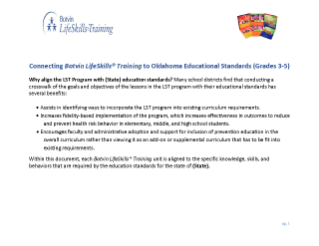
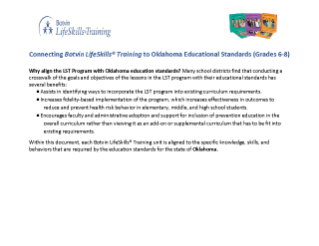
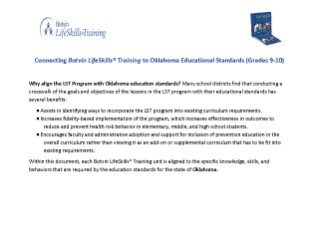
Botvin LST Aligned with Oklahoma Academic Standards
These crosswalks are designed to help educators and administrators quickly identify how implementing LST not only delivers vital substance abuse, violence, and social-emotional learning, but also fulfills key academic requirements in areas such as Health and Physical Education.

About Botvin LifeSkills Training
Top-Rated Substance Abuse Prevention Program
Botvin LifeSkills Training is based on more than 40 years of peer reviewed scientific research and now holds the distinction of being the top evidence-based substance abuse prevention program in the country.
Effectiveness:
- Lowers risk for prescription drug & opioid misuse
- Cuts tobacco use by 87%
- Cuts vaping by 70%
- Cuts alcohol use by 60%
- Cuts marijuana use by 75%
- Cuts polydrug use by 66%
- Cuts methamphetamine use by 68%
- Decreases use of inhalants, narcotics and hallucinogens
- Reduces violence
- Reduces risky driving behavior
- Demonstrates effects on HIV risk behavior

Violence and Delinquency Prevention
- Physical aggression reduced by 30%
- Verbal aggression reduced by 42%
- Delinquency reduced by 40%
- Fighting reduced by 40%

Duration of Effects
- Up to 12 years
Target Age
- Upper Elementary School: Grades 3-6
- Middle School: Grades 6-9
- High School: Grades 9 or 10
Program Components
- Teachers manual and student guide (for each year)
Providers
- Teachers, Peer Leaders, or Health Professionals
Program Length
- Elementary School program: 24 class sessions
- Middle School program: 30 class sessions
- High School program: 10 class sessions
Sources: (1) Journal of Behavioral Medicine (1983), (2) Journal of Studies on Alcohol (1984), (3) Journal of Consulting and Clinical Psychology (1990), (4) Journal of the American Medical Association (1995), and (5) Archives of Pediatric & Adolescent Medicine (2006). Preventing youth violence and delinquency through a universal school-based prevention approach. Prevention Science, (2006). Griffin, K. W., Williams, C., Botvin, C. M., Sousa, S. & Botvin, G. J. (2022). Effectiveness of a hybrid digital substance abuse prevention approach combining e-learning and in-person class sessions. Frontiers in Digital Health, 4, 931276
Frequently Asked Questions
WHAT IS THE BOTVIN LIFESKILLS TRAINING PROGRAM? Botvin LifeSkills Training (LST) is an evidence-based substance abuse and violence prevention program used in schools and communities throughout the U.S. and in 39 countries around the world. LST has been extensively tested and proven to reduce tobacco, alcohol, and illicit drug use by as much as 80%. It is effective when implemented with different delivery formats, when taught by different providers, and when delivered to different populations. It also works with elementary school, middle school, and high school students. Long-term follow-up studies show that it produces prevention effects that are durable and long-lasting.
WHAT ARE THE MAIN GOALS OF THE LST PROGRAM? The main goals of the LST program are to teach prevention-related information, promote anti-drug norms, teach drug refusal skills, and foster the development of personal self-management skills and general social skills.
HOW LONG IS THE LST PROGRAM AND HOW IS IT STRUCTURED?
The LST Elementary School program consists of 8 class sessions per year across all three years of upper elementary school. The elementary program can be implemented over one, two, or three years, depending on the availability of time. It is designed to be implemented either as a stand-alone program or in combination with the Middle School program.
The LST Middle School program is designed to be taught in sequence over three years in either middle or junior high school. The first year of the program has 15 class sessions (plus 3 optional violence prevention sessions), the second year contains 10 sessions (plus 2 optional violence prevention sessions), and the third year consists of 5 sessions (plus 4 optional violence prevention sessions).
The LST High School program comprises 10 class sessions. The LST Transitions program has 6 class sessions. Each program is typically taught in one year and can be used alone or as maintenance programs in combination with other LST programs.
DOES THE ENTIRE CURRICULUM NEED TO BE TAUGHT FOR THE PROGRAM TO BE EFFECTIVE? In order to be optimally effective, the LST program must be implemented carefully and completely. If the material is only partially covered, studies have shown the program is likely to be less effective. Implementation fidelity means teaching every unit of the program, in the sequence provided, for the specific number of sessions.
Fidelity is achieved by observing and practicing the following guidelines:
- Teach the full scope and sequence of the LST curriculum. Teach all lessons in the order given, making all of the teaching points in each lesson.
- Teach at least one time per week for consecutive weeks until all units are taught. The curriculum may be taught as an intensive mini-series (consecutively every day, or two to three times a week), or it can be taught once a week.
- Use interactive teaching strategies. Students acquire skills when interactive teaching skills (coaching, facilitation, behavioral rehearsal, and feedback) are used.
- Implement using the LST program materials. Provide each teacher with a Teacher’s Manual and each student with his or her own Student Guide.
IN WHAT ENVIRONMENT SHOULD LST BE TAUGHT? LST has been successfully taught in a variety of settings including school classrooms, after-school programs, summer camps, and community- and faith-based organizations.
WHO SHOULD TEACH THE LST PROGRAM FOR IT TO BE EFFECTIVE? The LST program is easy to use and can be effectively implemented by teachers, school counselors, prevention specialists, community youth educators, and other program providers.
IS LST EVIDENCE-BASED? LST is the most widely used evidence-based tobacco, alcohol, drug abuse, and violence prevention programs available. It is also one of the most comprehensive and rigorously tested prevention programs in America today. LST has been extensively tested and proven effective both by Dr. Gilbert J. Botvin and colleagues at Cornell University’s Weill Cornell Medical College and by a number of independent research groups.
HOW EFFECTIVE IS LST? Studies testing the effectiveness of LST show that it can reduce the prevalence of tobacco, alcohol, and illicit drug use by as much as 80%. It can also reduce multiple drug use by up to 66%. Research conducted for the elementary version of the program shows a 60% reduction in tobacco and alcohol use as well as increased self-esteem. LST has also been shown to reduce violent and aggressive behavior.
IS LST A GOOD INVESTMENT? Several independent studies show that LST makes good economic sense. The results of analyses examining the costs and economic benefits of LST have typically found that it produces a $45 savings for every $1 spent.
DO THE REDUCTIONS IN DRUG USE PRODUCED BY LST LAST? Yes. Several studies show that the LST program produces reductions in drug use that are long-lasting. Studies published in top scientific journals such as the Journal of the American Medical Association (1995), Addictive Behaviors (2000), the Archives of Pediatrics and Adolescent Medicine (2006), and the American Journal of Public Health (2013) or presented at major scientific conferences (2012) show that LST produces effects on drug use that last for up to 12 years after the initial baseline assessment. That means the effects of LST can last through high school and college and even into young adulthood.
WHAT DEMOGRAPHIC DOES LST WORK FOR? The LST program has been tested with a broad range of adolescents. So far, it has proven effective for every type of adolescent. Evaluation studies show that it works for Caucasian, Black, and Hispanic youth. It also works for boys and girls, and for adolescents living in suburban, urban, and rural environments.
WHAT AGE GROUPS DOES LST WORK FOR? LST has been tested and proven effective with several different age groups. So far, studies have shown that LST is effective with students in elementary school, middle/junior high school, and high school. Age-appropriate curriculum materials are available for each age group.
WHAT MAKES THE LST PROGRAM MORE EFFECTIVE THAN OTHER PROGRAMS? One of the distinguishing features of the LST program is that it is based on sound science. Many contemporary prevention programs are based on hunches, guesses, and wishful thinking. The LST program, however, is based on over 35 years of research concerning the causes of drug abuse and how to best prevent it. Another distinguishing feature of the LST program is that it emphasizes the use of interactive teaching methods.
ARE ALL “LIFE SKILLS” PROGRAMS EQUALLY EFFECTIVE? Several programs now use “life skills” in their title or refer to themselves as “life skills” programs. But only the Botvin LifeSkills Training program has been subjected to extensive testing in over 35 rigorous evaluation studies and proven to decrease adolescent tobacco, alcohol, and illicit drug use.
Last Modified on
Oct 15, 2026
