

Understanding Oklahoma's Teacher Workforce: Entry Pathways and Workforce Trends
Oklahoma's teacher workforce looks different today than it did a decade ago. Fewer teacher candidates are graduating from university-based teacher preparation programs. More educators are entering the classroom through alternative routes, some of which provide a structured path to full certification, and others that do not. Across all entry pathways, keeping teachers in the classroom beyond the first few years remains a persistent challenge.
A new dashboard, The State of Teaching in Oklahoma, released this month by the Office of Educational Quality and Accountability (OEQA), offers a transparent and data-informed view of these trends and provides a foundation for ongoing conversations and decision-making.
A Long-Term Decline in Educator Preparation Program Completion
As in many states, the primary route into teaching in Oklahoma is through university-based Educator Preparation Programs (EPPs). EPPs provide a structured sequence of coursework and supervised practice leading to a standard teaching certificate. Graduates of these programs are fully prepared, both pedagogically and contextually, to enter the classroom on day one.
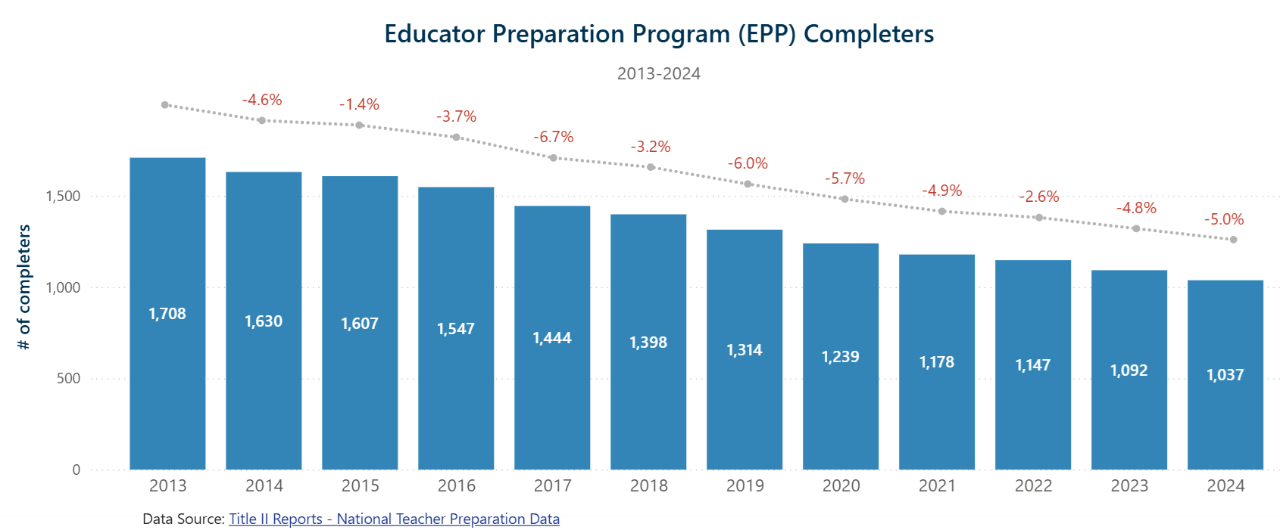
That pipeline has narrowed significantly over the last decade. In 2013, 1,707 teacher candidates completed traditional university-based EPPs. By 2024, that number had fallen to 1,037, a decline of 39.3% in just over a decade. Although university preparation programs continue to serve as a primary pathway into the profession, the decline in graduates suggests that districts are increasingly drawing on additional certification pathways to meet staffing needs.
Certification Trends Over a Decade
The decline in the number of teacher candidates graduating from university-based EPPs coincides with changes in certification patterns across the workforce. From 2016 to 2025-26, the share of Oklahoma teachers holding a standard certificate, meaning they have met the state’s preparation and certification requirements, has dropped from 92.8% to 87.8%. Over the same time period, two non-standard certification types, provisional and emergency certification, have grown to fill the gap.

Provisionally certified teachers are most often career changers entering the classroom from other professional fields. They must hold at least a bachelor's degree and pass the same certification examinations required of standard-certified candidates. Importantly, they are enrolled in a formal pathway toward full certification, completing required pedagogy coursework while they teach.
Emergency-certified teachers differ in one important aspect. They also must hold a bachelor's degree, but they are not enrolled in any formal process leading to standard certification. This certification type was designed as a short-term solution to critical staffing needs, allowing school districts to fill teaching positions when a certified teacher is not available for the role.
As these pathways expanded, the proportion of teachers holding provisional or emergency certification increased from 7.2% to 12.2% of the statewide workforce. These certification types provide districts with additional flexibility in staffing classrooms when traditional preparation pipelines do not fully meet workforce demand.
Entry Routes for First-Year Teachers
The changing mix of certification pathways is particularly visible among teachers entering the profession for the first time. At the beginning of the 2025–2026 school year, fewer than half (45.5%) of first-year teachers entered the classroom with a standard certificate. By comparison, 21% entered under provisional certification and 33.5% entered the profession with an emergency certificate, compared with 15.5% a decade ago.

Adjunct Teachers
Another pathway within Oklahoma’s educator workforce is the use of adjunct teachers. Adjunct teachers are employed by school districts based on qualifications established at the local level. Because hiring criteria are determined by districts, requirements may vary and may not always include completion of the same certification processes required for other teaching pathways or even a bachelor’s degree, which is typically required for other teaching certifications.
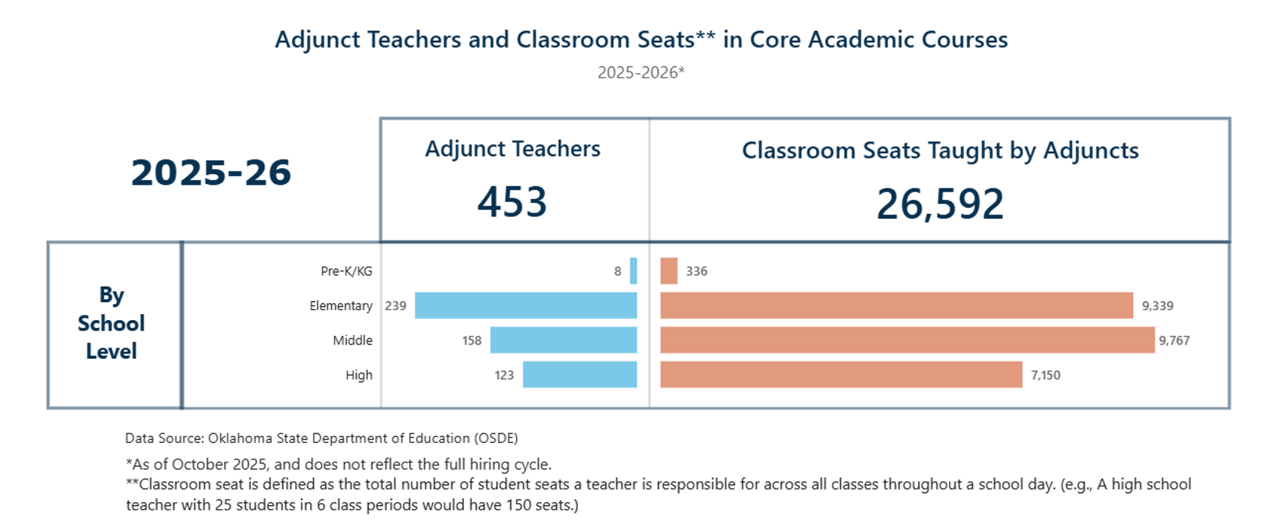
During the 2025–2026 school year, 453 adjunct teachers were serving in Oklahoma classrooms. Of these, 247 were teaching in pre-kindergarten, kindergarten, or elementary settings, while the remainder were teaching in other grade levels in core subject areas.
Teacher Persistence
Teacher workforce data also show differences in how long first-year teachers remain in the profession depending on certification pathway. Across cohorts, first-year teachers entering the profession with a standard certificate generally remain in the classroom at higher rates during the early years of teaching than those holding non-standard certifications.
In 2025, approximately 87% of standard-certified teachers remain in the profession after their first year of teaching. Persistence during the first year is slightly lower among provisionally certified teachers, at 84%, and lowest among emergency-certified teachers, at 69%.

Over time, persistence declines significantly across all certification pathways, a pattern that is commonly observed during the early years of teaching. Data from the 2022 teacher cohort, the most recent cohort with complete four-year persistence information, illustrate this trend. After the first year of teaching, 90% of standard-certified teachers from this cohort remained in the profession, compared with 87% of provisionally certified teachers and 80% of emergency-certified teachers. By the fourth year, 65% of standard-certified teachers from the cohort remained, compared with 51% of provisionally certified teachers and 41% of emergency-certified teachers.
Taken together, Oklahoma's teacher workforce is navigating real shifts. Understanding how educators enter the profession, how preparation pathways are changing, and how long teachers remain in the classroom provides important context for discussions about workforce stability and educator supply. By making these data publicly accessible, the dashboard offers educators, policymakers, and community members a shared foundation for understanding the current landscape of teaching in Oklahoma.
Readers interested in exploring the data further can access the interactive teacher workforce dashboard here: The State of Teaching in Oklahoma
Note: The Teacher Workforce Dashboard was developed by the Office of Educational Quality and Accountability (OEQA) in collaboration with the Oklahoma State Department of Education (OSDE) to provide accessible information about educator workforce trends in Oklahoma.
