


Depiction of a Building Fire, 1860. (Image provided by the National Council of Architectural Registration Boards.)
A Century of Public Protection
Building Failures Lead to Calls for Building Design Reform
In the late 1800s, advances in construction materials and methods led to grander and taller buildings across the United States. Skyscrapers began to dominate city skylines and building designers rushed to create the latest marvel. Soon, however, the grandeur and awe turned into horror and tragedy.
On December 30, 1903, less than one month after opening, a fire in Chicago's Iroquois Theater resulted in the deaths of over 600 people, including children. The magnitude of the mass casualty event was due to a perfect storm of design flaws - grates blocking exits to prevent people from sneaking into better seats, only one grand staircase that led to all levels of the theater which became jammed as patrons all tried to exit at once, exit doors that opened inward instead of outward and could not be opened due to the press of people, fire escapes that were never completed, and skylights meant to release heat that had been sealed shut.
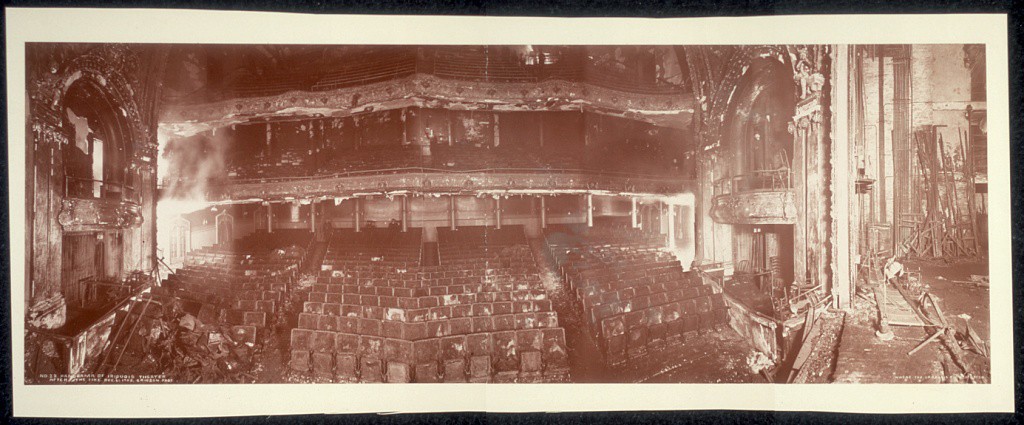 Chicago's Iriquois Theater after a fire killed over 600 people. (Image provided by the Library of Congress.)
In January 1922, a blizzard swept through Washington, D.C., blanketing the city in over two and a half feet of snow. The Knickerbocker Theater's flat roof could not support the weight of the heavy snow and split in half during a showing of a silent movie. The force of the falling roof blew out the theater's doors and windows, and resulted in the deaths of 98 people and the injury of hundreds more.
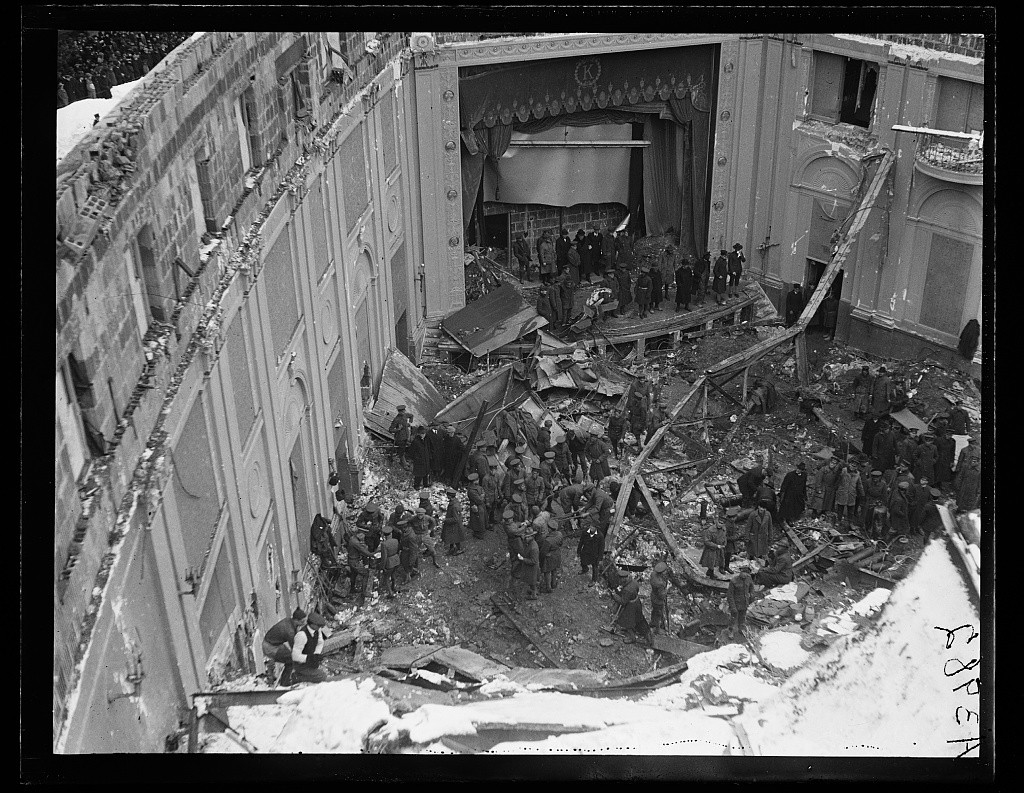 The Knickerbocker Theater after its roof collapsed due to the heavy weight of snow. (Image provided by the National Council of Architectural Registration Boards.)


- Depiction of a Building Fire, 1860. (Image provided by the National Council of Architectural Registration Boards.)
- Cartoon Depiction of Another Building Failure, date unknown. (Image provided by the National Council of Architectural Registration Boards.)
- Triangle Shirtwaist Factory Fire, NYC, 1911. (Image provided by the National Council of Architectural Registration Boards.)
- 1922 Knickerbocker Theater Roof Collapse. (Image provided by the National Council of Architectural Registration Boards.)
Following these and other building failures, calls began across the United States for oversight and reform in building design and construction. Many states created a license to ensure that Architects were competent to use modern technologies to design buildings that were safe for the public.
The Beginning of Licensure in Oklahoma
By 1925, architecture in Oklahoma had become a powerful reflection of the state’s rapid transformation—from frontier settlements to modern urban centers. But with growth came complexity: cities were expanding, construction technologies were advancing, and public safety was increasingly recognized as a critical concern. Fires, collapses, and sanitation failures had shown that beauty without safety was a dangerous illusion.
That year, during the regular session of the Tenth Legislature of the State of Oklahoma, state legislators passed Senate bill 113, which formed the State Board of the Examiners of Architects and created a license for regulating Architects. For the first time, Architects in Oklahoma were licensed, regulated, and accountable—not just to clients, but to the public. This act laid the foundation for a broader vision of professional responsibility.
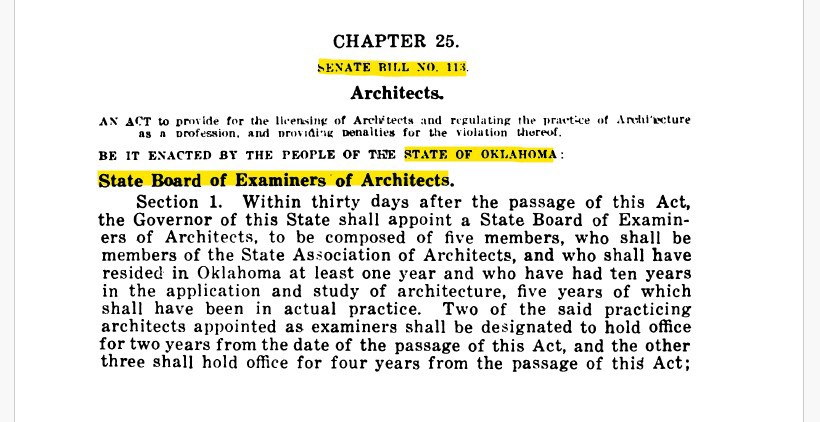 Text of Senate bill 113, which created the Oklahoma State Board of Examiners of Architects. (Image provided by the Oklahoma Historical Society.)


- 1906 Bulletin for Architects. (Image provided by the Oklahoma Historical Society.)
- 1904 Downtown Tulsa. (Image provided by the Oklahoma Historical Society.)
- Oklahoma State Capitol Under Construction. (Image provided by the Oklahoma Historical Society.)
- Oklahoma State Capitol, 1917. (Image provided by the Oklahoma Historical Society.)
- Oklahoma State Capitol, 1925. (Image provided by the Oklahoma Historical Society.)
- Oklahoma City Capitol and Downtown Modern View.
The Oklahoma Board of Architects, Landscape Architects and Licensed Interior Designers
In 1984, regulation of Landscape Architects was added to the Oklahoma Board of Architects and then, in 2007, the voluntary regulation of Registered Interiors Designers was added. In 2025, the voluntary registration for interior designers became a license that expanded the scope of work for License Interior Designers and recognized the competency they achieve through their education, experience, and examination.
Currently, the Board is made up of eleven members: six Architects, two Landscape Architects, two Licensed Interior Designers, and one public member. Each Board member is appointed by the Governor and sits on the Board to ensure the protection of Oklahomans by continually updating the requirements for licensure to match the ever-changing landscape of technology and trends, by making sure that only those who demonstrate competency are allowed to practice, and by collaborating with other licensed professions to maintain safety in the built environment.


- Architectural Drawing Room, 1867. (Image provided by the National Council of Architectural Registration Boards.)
- University of Oklahoma Architecture Lab, 1934. (Image owned and provided by the University of Oklahoma Board of Regents.)
- University of Oklahoma Architecture Students, 1948. (Image owned and provided by the University of Oklahoma Board of Regents.)
- Proctored Architectural Registration Exam, date unknown. (Image provided by the National Council of Architectural Registration Boards.)
- Computer-administered Architectural Registration Exam, date unknown. (Image provided by the National Council of Architectural Registration Boards.)
The Professions
Architecture is a public safety profession that ensures the spaces we rely on daily—schools, clinics, libraries, churches, and government buildings—are designed to protect lives and promote well-being. Architects uphold rigorous standards for fire safety, structural integrity, accessibility, and the ability to withstand environmental challenges such as extreme weather and aging infrastructure. Their work not only strengthens community assets but also fuels economic growth by creating durable, efficient buildings that support education, healthcare, and civic life.
Landscape architecture is an essential profession that weaves together design, ecology, and engineering to shape spaces to be safe, accessible, and resilient for both public and private use. Landscape Architects safeguard communities by creating parks, streetscapes, campuses, and green infrastructure that mitigate flooding, reduce urban heat, and promote public health. From restoring wetlands and designing trail networks to realizing vibrant urban plazas, their work fosters environmental stewardship and elevates the quality of life for all.
Licensed Interior Designers play a vital role in protecting public health, safety, and welfare through the thoughtful design of interior environments. Their expertise ensures that spaces like hospitals, schools, government buildings, and workplaces meet building codes, fire safety standards, and accessibility requirements while supporting functionality and well-being. By shaping interiors that are safe, efficient, and responsive to human needs, Licensed Interior Designers contribute to resilient communities and a higher quality of life across the state.


- Architecture: OKC Downtown
- Architecture: Tulsa Downtown
- Landscape Architecture: Scissortail Park
- Landscape Architecture: Tulsa Park
- Licensed Interior Design: Hotel Lobby
- Licensed Interior Design: Capitol Rotunda
Last Modified on
Sep 10, 2025