

Oklahoma and Dawn Aerospace Announce Seven Research Teams Selected for 25 Suborbital Spaceplane Flights
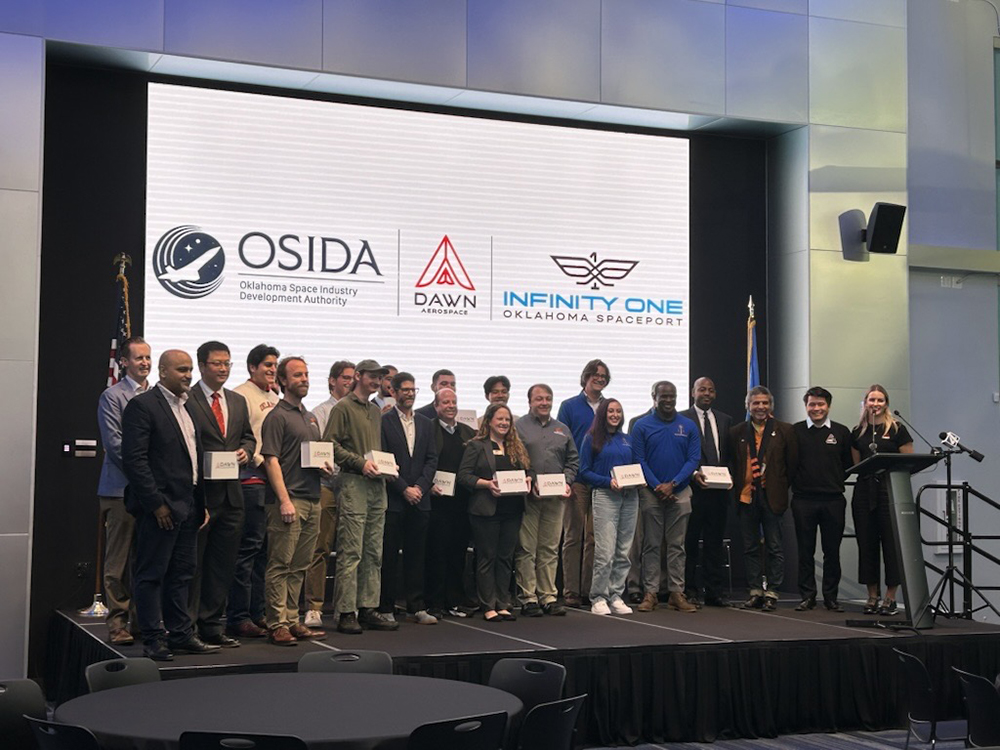
Oklahoma and Dawn Aerospace Announce Seven Research Teams Selected for 25 Suborbital Spaceplane Flights
University-led teams will advance biomedical and aerospace research aboard Aurora from Infinity One Oklahoma Spaceport
OKLAHOMA CITY — Dawn Aerospace alongside the Oklahoma Space Industry Development Authority (OSIDA) Thursday announced seven winning research teams in the Suborbital Spaceplane Challenge. The winning teams, led by Oklahoma universities and joined by partners from across the United States and Europe, will share 25 flights on Dawn’s suborbital spaceplane, Aurora, to be flown from Infinity One Oklahoma Spaceport located in the western part of the state.
The Challenge exists to give the state’s researchers direct, repeatable access to space-like conditions and positions Oklahoma as a home for a new kind of micro-gravity flight research: experiments that take off from a runway, fly to the edge of space and land again the same morning.
“Oklahoma has made strategic investments in our aerospace infrastructure, workforce, and research capabilities to create opportunities exactly like this,” said Grayson Ardies, executive director of the Oklahoma Department of Aerospace and Aeronautics and CEO of the Oklahoma Space Industry Development Authority. “The Suborbital Spaceplane Challenge puts that investment to work for our universities. These seven teams are doing serious science, from cancer and immune research to the hardware future spacecraft will depend on, and they will be doing it from Oklahoma.”
Infinity One Spaceport occupies the former Clinton-Sherman Air Force Base, whose long runway and broad downrange airspace suit the high-cadence suborbital flights Aurora is designed for. Construction for Aurora’s operations is underway at the spaceport, with commercial flights planned to start in late 2027.
“Biologists, spacecraft engineers, and scientists all asked for the same thing: access to space, to get the experiment back, learn from it, and fly again as quickly as possible. That is exactly what Aurora is built for. It’s great to see the State of Oklahoma use this capability to supercharge their researchers and motivate out of state and international research institutes to come to Oklahoma too.” said Stefan Powell, CEO of Dawn Aerospace.
“Dawn Aerospace’s partnership with Oklahoma is about more than advancing spaceflight," said Barbra Coffee, Oklahoma Commerce Executive Director of Economic Development, Growth and Expansion. "It’s creating new opportunities for our universities, researchers and businesses to be part of a growing industry. Oklahoma is positioning itself at the forefront of the next generation of space exploration and innovation while putting our students in position to be ready for the jobs of tomorrow.”
The Winners
Winners were selected after a final review of 12 finalist submission. Each winner will be allocated 3-5 dedicated flights. The seven winning teams are, in no particular order:
AstroTwitch – Muscle tissue research
Lead: Oklahoma State University | Partner: ETH Zurich
Muscle loss is one of the best-known effects of spaceflight on the body. AstroTwitch will study how muscle tissue responds to microgravity, building knowledge relevant to astronaut health and to muscle-wasting conditions on Earth.
Carbon-Carbon Leading Edge – High-speed thermal protection
Lead: University of Tulsa, High Temperature Composite Materials Research Group
Carbon-carbon composites protect the leading edges of high-speed vehicles from extreme heat. Flying on Aurora exposes samples to repeatable and real world conditions that cannot be achieved in a laboratory environment.
INFLATE – Inflatable structures in microgravity
Lead: Oklahoma State University, Oklahoma Aerospace Institute for Research & Education
Inflatable structures could make future spacecraft, habitats and antennas lighter and easier to launch. INFLATE will test how they deploy and behave in microgravity and near-vacuum.
Low-Cost Star Tracker Array
Lead: University of Oklahoma, School of Aerospace and Mechanical Engineering | Partner: University of Colorado Colorado Springs and SEDS OU
Star trackers tell a spacecraft where it is pointing. This team will test a low-cost array above the bulk of the atmosphere, where Aurora can hold any attitude and point at targets in the sky.
MitoTRACER – Cancer cell mitochondrial transfer
Lead: University of Oklahoma Health Sciences Center | Partner: University of Pittsburgh (Trivedi Institute for Space & Global Biomedicine / McGowan Institute for Regenerative Medicine) and Washington University School of Medicine
MitoTRACER will investigate how mitochondria transfer between cells in response to space-related stressors, with potential implications for understanding a range of health conditions, including cancer, Long COVID and neurodegenerative diseases.
Modular Tank PMD Test Bed
Lead: Oklahoma Baptist University | Partner: Quantum Space
Propellant management devices (PMDs) control how fuel moves inside a tank when there is no gravity to settle it. This test bed will study that behavior in real microgravity, with direct relevance to refueling and in-space propulsion.
T-GRAV – Human T-cell response to reduced gravity
Lead: Langston University
T-cells are central to the immune response. T-GRAV will examine how they behave in reduced gravity, using Aurora’s ability to provide microgravity as well as lunar and Martian gravity levels.
Why Aurora for New Science
Most researchers have had two ways to test in space-like conditions: brief parabolic aircraft flights or rare, costly rides on rockets, and orbital missions. Aurora offers a third option. It is an uncrewed, rocket-powered aircraft that takes off from a conventional runway, flies its payload to the edge of space and glides back to land, ready to fly again.
For researchers, that means:
Real microgravity, and more than one kind of gravity. On a suborbital profile, Aurora is designed to provide up to 127 seconds of high-quality microgravity, depending on payload mass. By controlling its rotation, it can also simulate lunar gravity (0.17 g) or Martian gravity (0.38 g).
Samples back in minutes. Payloads are recovered and handed to the team within minutes of landing. For biology, where cells and tissue change quickly, getting the experiment back fast matters as much as getting it up.
Campaigns, not one-off shots. Aurora is designed to fly twice a day with a four-hour turnaround. Teams can fly, review data, adjust and fly again, building results over repeated flights rather than betting everything on one launch.
High-speed and high-altitude flight. Beyond microgravity, Aurora is designed to fly boost-glide profiles at up to Mach 3.7, giving engineering teams a real flight environment for thermal, aerodynamic and hardware testing.
Precise pointing. In microgravity, Aurora can hold any attitude and point payloads at targets in space or on the ground to within 2°.
Simple integration. Payloads up to 15 kg (33 lb) fit in a 250 mm cube (9.8 inch) with standard power and Ethernet. Teams get live telemetry, flight data and video, and a Dawn mission manager who handles flight planning and safety assessment.
Researchers interested in flying on Aurora can find the Mission User’s Guide and contact the missions team at dawnaerospace.com or missions@dawnaerospace.com. More on the Challenge: dawnaerospace.com/suborbital-spaceplane-challenge
