If you answered “Yes” to either of these statements, you are required to file an Oklahoma income tax return.
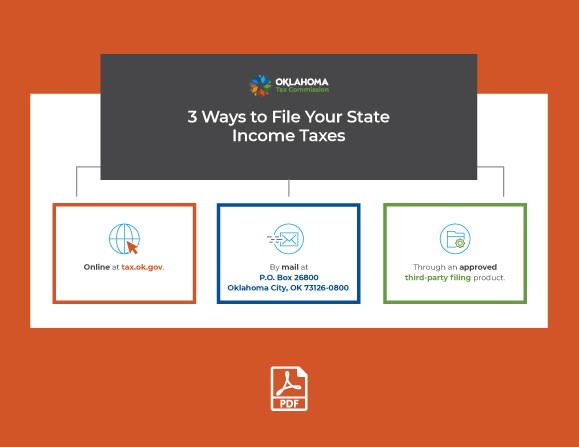
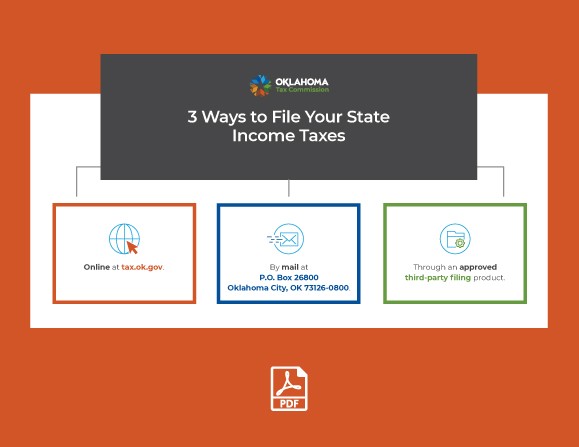
1. Online at oktap.tax.gov.
2. By mail at P.O. Box 26800, Oklahoma City, OK 73126-0800.
Click here to see USPS's Postmark update.
3. Through an approved third-party filing product.
Visit OkTAP to see if you qualify to file for free.
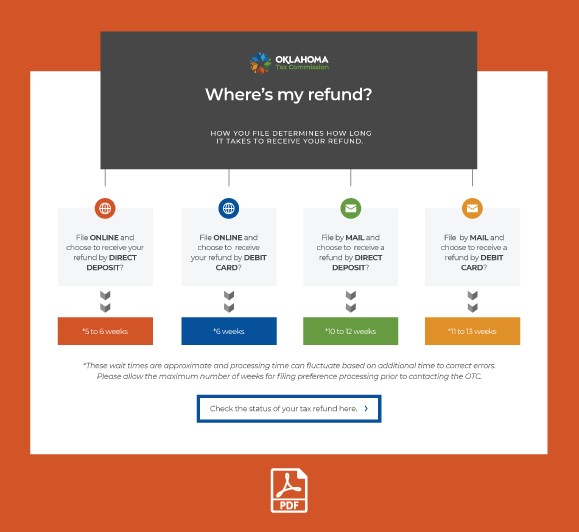
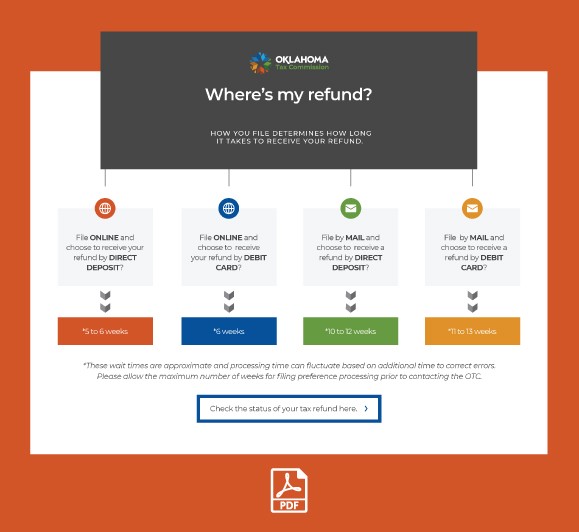
If you have filed your individual income tax return, you can check the status of your refund with the Where's My Refund tool at OkTAP. How you filed will determine the processing time for your return.
To claim Oklahoma's standard deduction, you must also claim the standard deduction on your federal return.
2019 & 2020 | Filing Status |
$6,350 | Single or Married Filing Separate |
$9,350 | Head of Household |
$12,700 | Married Filing Joint or Qualifying Widow(er) |
Itemized Deductions
Federal itemized deductions must be adjusted by adding back state and local sales or income taxes to arrive at Oklahoma itemized deductions. Oklahoma itemized deductions will be capped at $17,000, excluding charitable contributions and medical expenses which are not subject to the $17,000 cap. If you claimed itemized deductions on your federal return, you must claim itemized deductions on your Oklahoma return. This is true even if the Oklahoma itemized deductions are less than the Oklahoma standard deduction.
Information for all Deductions and Exemptions
In the case of resident individuals having income from sources both within and outside the State of Oklahoma, the standard or itemized deductions and personal exemptions will be reduced to an amount which is the same portion of the total of Oklahoma adjusted gross income (AGI) to federal AGI.
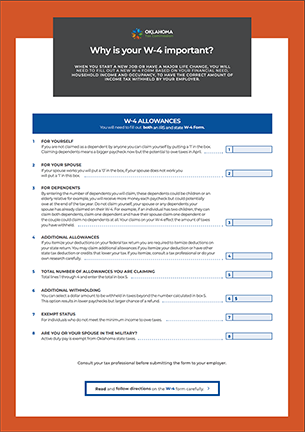
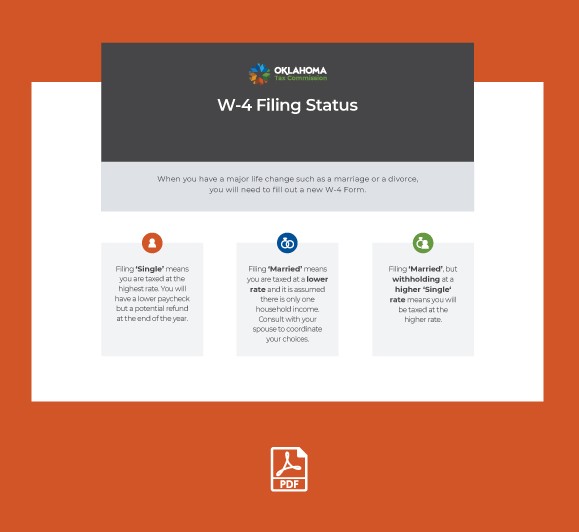
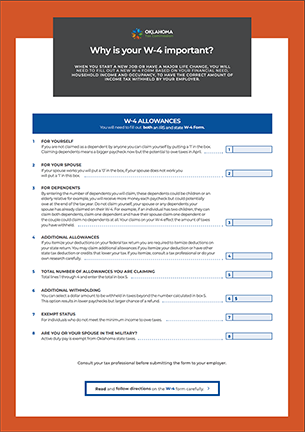
When you start a new job or have a major life change, your tax filing status may need to change too. You will need to fill our a new W-4 form based on hour financial need, house hold income and occupancy, to have the correct amount of income tax withheld by your employer. Talk with your tax professional to determine the filing status that works best for you.
Does the W-4 form seem confusing? Click HERE to for a detailed explanation of each line of the W-4 form.
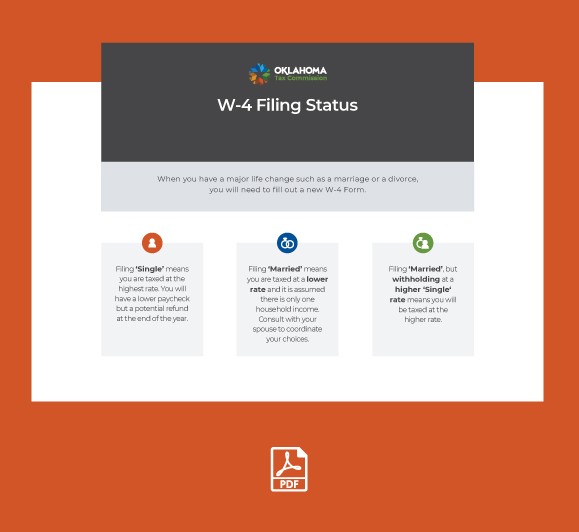
When you have a major life change, your tax filing status may need to change too. Learn more about the types of tax filing statuses. Talk with your tax professional to determine the filing status that works best for you.
• Filing ‘Single’ means you are taxed at the highest rate. You will have a lower paycheck but a potential refund at the end of the year.
• Filing ‘Married’ means you are taxed at a lower rate and it is assumed there is only one household income. Consult with your spouse to coordinate your choices.
• Filing ‘Married', but withholding at a higher ‘Single‘ rate means you will be taxed at the higher rate.